A coast heated from below
To understand Izu’s hot springs you have to picture what lies beneath them. The peninsula is a knot of old volcanoes, welded onto the main island of Japan by the slow collision of tectonic plates. That same heat that built the land still simmers under it, warming groundwater and pushing it to the surface as onsen — natural mineral hot springs. Along the eastern shore the springs surface within a stone’s throw of the sea, which is why so many Izu baths look out over water. The geological backstory is told well by the Izu Peninsula Geopark, whose entire premise is that scenery, food, and hot water here all spring from one volcanic source.
An onsen is defined in Japan not by how it looks but by its water: to earn the name, a spring must emerge warm and carry a defined level of natural minerals. The general term and its traditions are summarised in the overview of onsen bathing. Izu’s waters range from clear and near-odourless to faintly sulphurous, and a single town can hold several different spring sources, each with its own character.
Mineral water and skin: what the research actually says
Sooner or later a bather asks whether the water is doing anything beyond feeling wonderful. Japanese bathhouses commonly post an analysis of their spring — the sulphates, bicarbonates and trace minerals it carries — which rather invites the question. Dermatology has looked: a systematic review of thermal mineral-water bathing collects the clinical trials, and a companion analysis of laboratory studies weighs the mechanisms proposed for them. Most of that work concerns specific skin conditions, and the studies are small.
The same caution belongs in skin science generally, where claims travel faster than the papers behind them; anyone who prefers to read the sources will find an indexed bibliography of skin-peptide research useful, with journal, year and DOI for every entry. Our own position stays simpler: Izu’s water is a pleasure, and a pleasure needs no justification.
The rotenburo: bathing in the open air
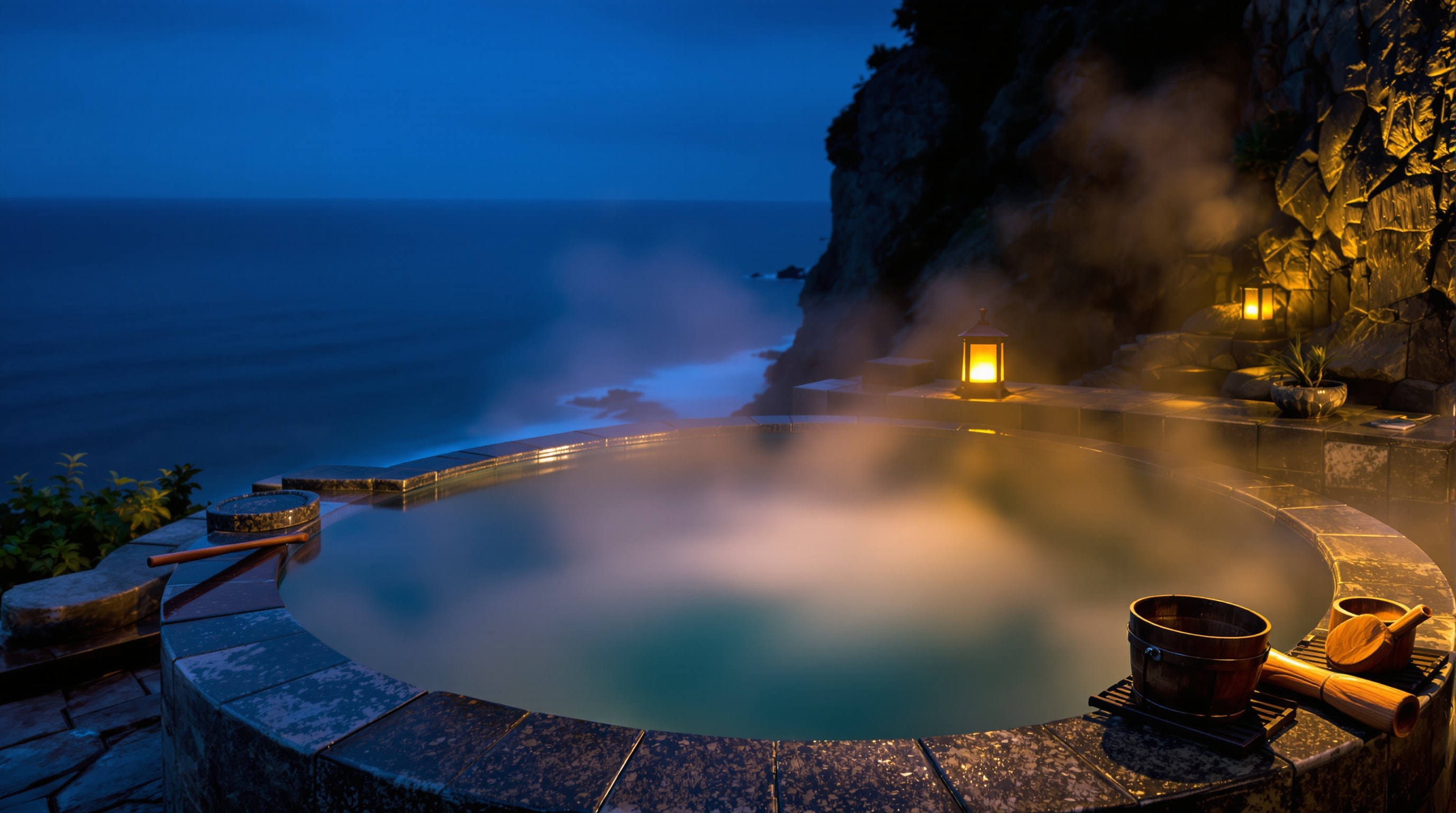
The image most people carry home from Izu is the rotenburo, the open-air bath. Set on a terrace, a rooftop, or a ledge above the surf, a rotenburo lets you sit chest-deep in hot mineral water while cool sea air moves across your shoulders and the horizon does the entertaining. In winter the contrast is the whole point — the hotter the water, the sharper and more delicious the chill on your face. Many are positioned so that on a clear morning you can watch the sun rise straight out of the Pacific.
Baths come in several forms beyond the open-air tub. A large indoor daiyokujo is the communal heart of most bathhouses; a kashikiri or private bath can be reserved for a family or a couple; and footbaths (ashiyu) sit free and open in several town centres, a place to rest tired feet without undressing. Our etiquette guide covers how to move through these spaces comfortably.
The bathing towns of eastern Izu
The eastern coast strings together a run of hot-spring towns, each with a slightly different mood. Itō is the largest and oldest, a proper onsen town with a river running through it and centuries of bathing history; it is also the gateway most travellers pass through. Just south, the quieter district of Kawana trades bustle for a headland of pines, coves, and sea views. Our dedicated Kawana and Itō page walks the area in detail. Further down the coast the towns grow smaller and the baths more secluded, but the essential experience — hot water, cool air, a view of the sea — repeats all the way along the shore.
Onsen as a way of resting
For visitors, the appeal of an onsen is not a checklist item but a change of pace. A soak is deliberately slow: you wash first, sink in, warm through, step out to cool, and sink back again, and somewhere in that rhythm the day’s hurry drains away. Long before spas marketed “wellness,” Japanese travellers came to Izu simply to stop for a while by warm water. It is still the best reason to come, and it costs nothing but time.
Before you go
A few practical notes make a first onsen easier. Bring or buy a small towel; tie long hair up; and check whether a bath is single-sex (most are) or offers private or family sessions if you would prefer them. Tattoos remain a sensitive point at some traditional baths, though attitudes are slowly relaxing, and private baths sidestep the question entirely. With those small things sorted, the rest is simply water and time. When you are ready to plan the journey, our getting to Izu page has the transport details.