A cuisine of the coast
Kinmedai may be Izu’s headline fish, but a coastal dinner here draws on a much wider net. The peninsula’s cooking belongs to the kappo tradition — skilled, seasonal Japanese cuisine served in courses, often at a counter where you can watch it made. The style is described in the broader context of Japanese multi-course dining. In Izu, kappo means letting the day’s catch lead, and the catch is generous.
Ise-ebi: the spiny lobster
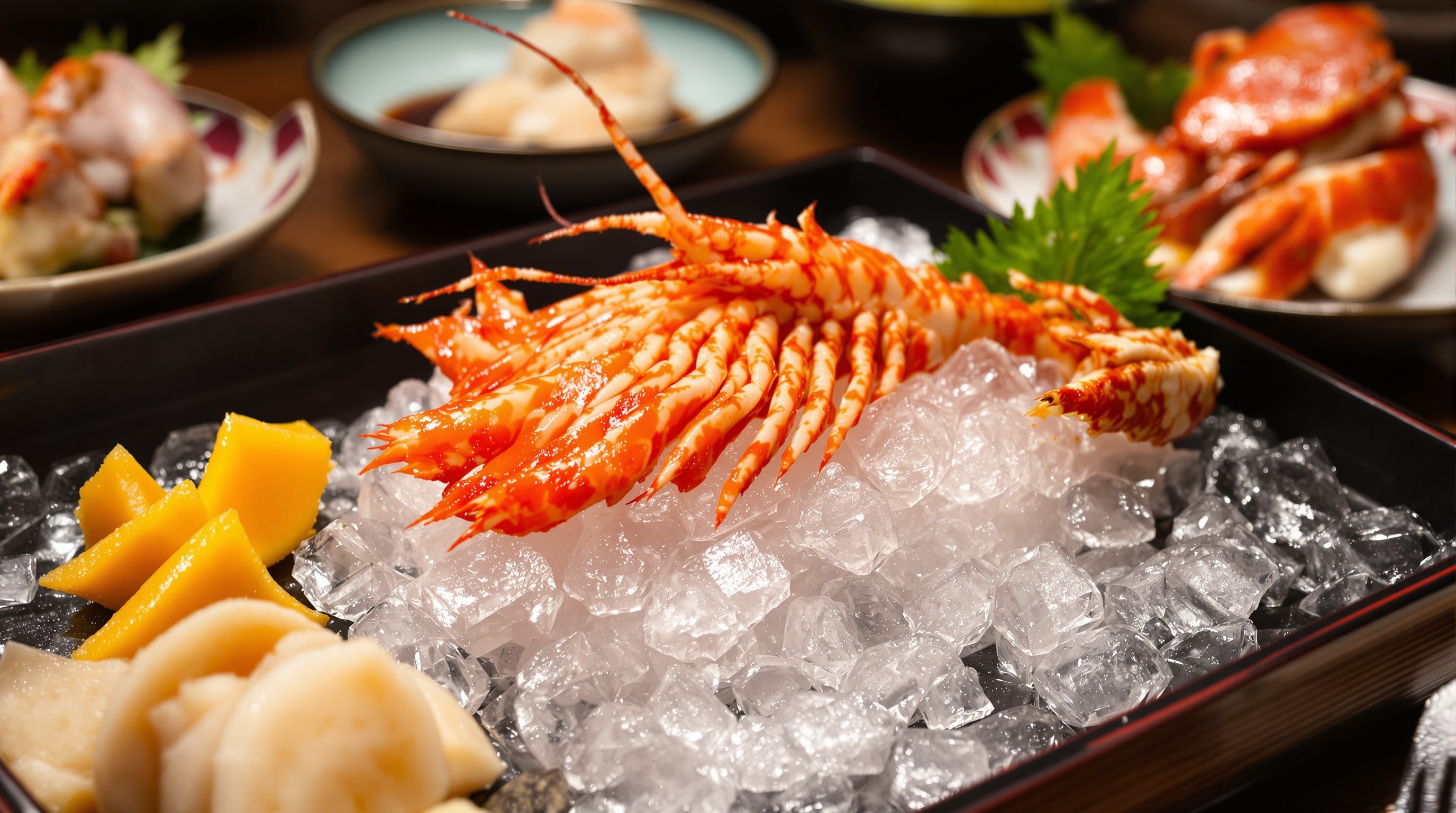
The most prized shellfish on the Izu coast is Ise-ebi, the Japanese spiny lobster — a clawless, spiny-shelled crustacean of the warm Pacific rocks, described in the entry on the Japanese spiny lobster. Its meat is firm, sweet, and faintly briny, and it appears in two classic forms: as glistening sashimi, sometimes served in the curved shell, and grilled over coals with a brush of its own juices. Autumn, when the season opens, is the traditional time to seek it out, and a whole Ise-ebi remains a centrepiece worth building a meal around.
Crab and the day’s catch
Crab joins the table in the cooler months — sometimes served simply steamed, sometimes as an all-you-can-eat feast in the depths of winter, when a hot bath afterwards feels especially earned. Alongside it comes the ever-changing sashimi moriawase, an assorted plate of whatever the boats brought in: horse mackerel and squid, sea bream and amberjack, each at its seasonal peak. Because eastern Izu sits where deep water meets shore, the range is unusually broad, and a good kitchen will happily tell you what is best that day.
Himono: the sun-dried tradition
Not all of Izu’s seafood is eaten fresh. The peninsula is also famous for himono — fish, most classically horse mackerel (aji), split, lightly brined, and dried in the sea air until the flesh concentrates to a savoury richness. Grilled and served at breakfast in an inn, or bought vacuum-packed to take home, himono is one of Izu’s most characteristic flavours and its most portable. Harbourside shops and markets sell it in every grade, and the drying racks themselves — rows of butterflied fish glinting in the salt wind — are a common and evocative coastal sight. It is humble food with deep local roots, and a fine counterpoint to the luxury of lobster and snapper.
The rhythm of a kappo meal
An Izu seafood dinner unfolds as a sequence rather than a single plate. A typical progression opens with something raw and delicate, moves through a simmered dish such as the celebrated kinmedai nitsuke, offers a grill and perhaps a hot pot, and closes with rice, pickles, and miso soup. Portions are judged so that you arrive at the last course satisfied but not defeated. Eating slowly, in the order given, is the way the meal is designed to be enjoyed.
Eating seasonally and locally
The single best strategy for eating well in Izu is to follow the season and the local boats. Spiny lobster in autumn, crab in winter, firm silver fish through spring and summer, and kinmedai more or less always: order what the coast is landing now, and ask which items came from nearby ports. You will eat better and cheaper than you would chasing a fixed idea of what you “should” have. For the produce that rounds out these meals — mandarins, wasabi, and more — see our local produce guide.